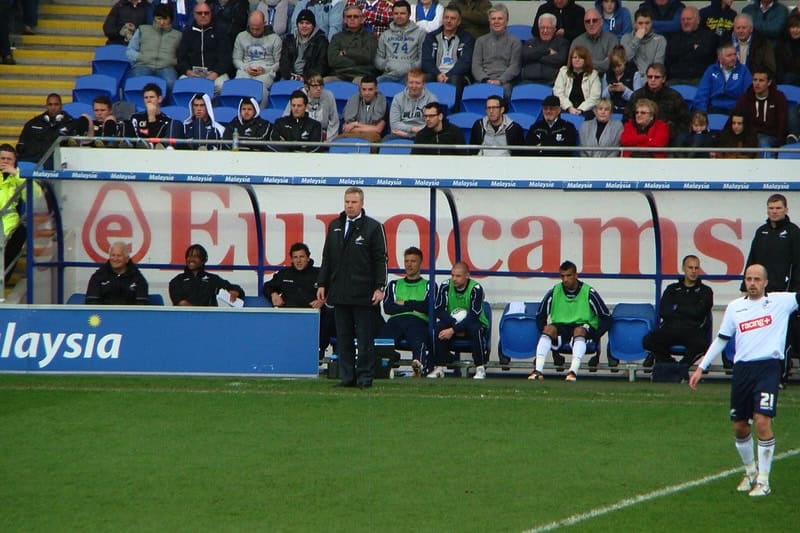
On the 11th of June, 2026 Kenny Jackett died, with the club announcing the sad news the following day. The terms legend and hero are used all too freely but the former midfielder, who could also operate in both central defence and at left-back, is a true Hornets icon and club hero.
Jackett was born in Watford, was raised not far from Vicarage Road (he said he could see the floodlights from his bedroom window) and was the son of a man who played for Watford. He joined the club at the age of 12 and never really left. He spent almost his entire junior career and his whole senior career at Watford. Then, when he finished playing, all too soon, he moved into a coaching role with his team, then going on to become Hornets manager. He lived and breathed Watford.
Playing Career
Watford through and through 💛 pic.twitter.com/Z7pNRKCTQU
— Watford Football Club (@WatfordFC) June 12, 2026
Jackett’s playing career was, like his life, cut sadly short. The cause of his death has not been made public, but it was persistent knee problems that ended his time as a player. He had his first knee operation when just 21. After a decent spell without issues they came back when he was 26. He was ultimately forced to quit the team and game he loved in 1990 when he was just 28 years old. Despite having several knee surgeries, he was just not able to go on, so he retired several years earlier than he, or the club, would have liked.
Watford Debut
Even so, between making his debut for the Hornets as a callow 18 year old in 1980 and his final game 10 years later, he amassed 428 appearances for the club. That is enough to see him eighth in terms of all-time appearances for the Hertfordshire side and we can only wonder how many more times he would have turned out for his childhood team had injuries not intervened.
Although he was born in Watford, his father, who was also a midfielder, and played for the Hornets between 1949 and 1953, was Welsh. Jackett junior made his international debut in September 1982 when he was just 19. In all he appeared 31 times for the land of his father, the last of those coming in 1988.
Career Highlights
He had many highlights on the pitch and while making his debut for Wales must have been special, he no doubt felt just as proud when turning out for the first time for the team he supported. Jackett was an integral part of the side that won promotion into the top flight in 1981/82, when they finished second.
Graham Taylor spotted his ability early and helped by other club legends, such as Luther Blissett, Jackett and Watford stunned the football world by finishing second in the old First Division in their first-ever season at that level. It was a remarkable rise for a club that had been in the fourth tier in the spring of 1978. Taylor, of course, takes most of the credit for the Hornets’ heroics. In terms of players, the likes of Blissett, striker Ross Jenkins and, of course, John Barnes, often get much of the attention but Jackett was also vital to their progress.
FA Cup Final
Having established themselves in the top tier of English football, and had an adventure in the UEFA Cup, Watford also made it to the FA Cup final in 1984. Jackett, who was just as good at the back as he was further forward, was the club’s number 10 that day but he could do little to stop an exceptional Everton side winning 2-0.
Injuries Mean Move into the Dugout
When Jackett was forced to call time on his playing career there was only one thing he was ever likely to do and that was continue working in one capacity or another with the club he loved. His leadership qualities always made him a likely candidate for management and he had all his coaching qualification at the time of his retirement.
His initial step up to become manager was awkward as he was working under Graham Taylor, who had returned to Vicarage Road but as a General Manager, something akin to a sporting director. At the end of the 1995/96 season Jackett became the sole, permanent manager, with Taylor the director of football.
Watford had slumped to the third tier and Jackett was unable to earn them an instant promotion. For the following campaign he was essentially demoted, with Taylor once again becoming the main man and Jackett his deputy as the main coach for the first team. The duo again enjoyed success, as they had when the younger man was a player, earning consecutive promotions before a poor season in the PL in 1999/2000 when they were relegated.
Life After Watford
It is with great sadness that we announce the passing of our former player and manager Kenny Jackett.
A true club legend and one of our own, Watford-born Kenny was instrumental in some of our greatest successes as a player before going on to serve as coach and then manager.
Our… pic.twitter.com/5kvSvrjsYS
— Watford Football Club (@WatfordFC) June 12, 2026
Taylor was replaced by Italian Gianluca Vialli and that spelt the end of Jackett’s long, long association with the Hornets. He would go on to a number of coaching and management roles at other clubs, including QPR, Swansea, Wolves, Millwall and Portsmouth.
He took charge of the Lions for over 300 games and it is with them that many younger fans will associate him. He got Millwall promoted out of League One in 2010, having earlier achieved promotion with Swansea. He also guided the Swans to success in the Football League Trophy.
He left Millwall to join Wolves and this was another successful time in his managerial career. Jackett was in charge in the Black Country for three years and 150 games. He was manager when the club won the League One title in 2013/14 and he won 46% of his games as Wolves boss.
He had brief stints with Rotherham and Leyton Orient after that, either side of a much longer stay as Portsmouth manager. He stayed on the south coast for almost four years, winning almost 51% of the 211 games he took charge of. That was the best win percentage he achieved at any club and he took Pompey to back-to-back EFL Trophy finals, winning the first in 2018/19.
His managerial career was certainly more diverse than his time as a player and his loss will be felt keenly at a number of clubs. However, everyone at Vicarage Road knows what a true Watford man Jackett was, a genuine, bona fide legend.